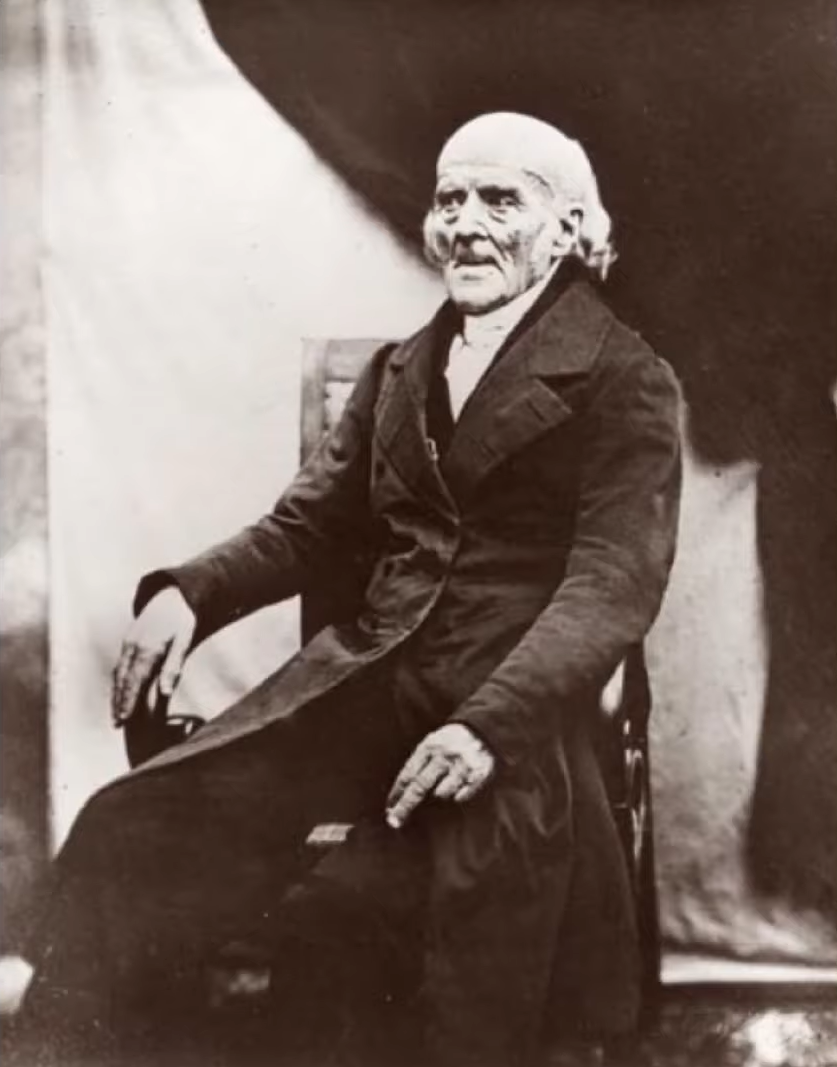
Samuel Hahnemann
Samuel Hahnemann (1755–1843) was the German physician who founded homeopathy. Born in Meissen, Saxony, the son of a porcelain painter, he trained in medicine at Leipzig, Vienna and Erlangen, and spent his early career as a doctor, chemist and prolific translator of medical texts. Disillusioned with the bloodletting and purging of the medicine of his day, he began testing medicinal substances on himself and on healthy volunteers, and in 1796 set out the principle of similars — that a substance which produces symptoms in a healthy person can treat the same symptoms in a sick one.
He developed the idea over half a century: the Organon of Medicine (1810, revised through six editions), the six volumes of the Materia Medica Pura recording his provings, and The Chronic Diseases, written in his seventies. After years in Leipzig, Torgau and Köthen he married Mélanie d'Hervilly and moved to Paris in 1835, where he practised until his death at eighty-eight. His case journals and some 6,000 patient letters are kept by the Institute for the History of Medicine of the Robert Bosch Foundation in Stuttgart, which publishes them as a free digital edition.
Complementary to, not a replacement for, medical care.
Teachings & Talks
Videos


The Curated Archive
Books & Literature


No Cost, No Catch